Valencia Test Preview: MotoGP’s 850cc Pirelli Era Begins
Event / announcement: October 17, 2026
The 2026 MotoGP season ends on Sunday 29 November, but the most important day for the 2027 championship comes two days later. On Tuesday 1 December, Circuit Ricardo Tormo hosts a one-day test that will be the first official group outing for MotoGP’s new generation of machinery: 850cc prototypes running on Pirelli tyres, ridden by a grid that has been reshuffled more thoroughly than at any point in recent memory.
The date was confirmed in MotoGP’s 2027 winter testing schedule, published at the start of September and reported by The Race and Crash.net. It is the traditional post-finale test, moved a week later than originally planned because the postponed Qatar Grand Prix pushed Portimão and Valencia back in the calendar. That shift means the test falls on the first day of the winter testing ban period, which runs from 1 December to the end of January. Crash.net noted in March that an exemption can be granted for the session, and every published schedule since has kept the 1 December date.
What is changing for 2027
The 2027 regulations are the biggest technical reset MotoGP has undergone in years. Engine capacity drops from 1000cc to 850cc, and Pirelli replaces Michelin as the single tyre supplier. Several other changes arrive with them, but those two alone mean that almost everything teams have learned about set-up, tyre management and electronics over the past decade must be rebuilt from scratch.
- Engines: 850cc, down from the current 1000cc.
- Tyres: Pirelli takes over from Michelin as the sole premier-class supplier.
- Concessions: the ranking system resets for 2027, which affects who may take part in the January shakedown.
- Homologation: according to Crash.net, engine designs and initial aero packages are frozen at round one of 2027.
- Calendar: the 2027 season opens with the Thai Grand Prix at Buriram on 5–7 March.
Why one day matters so much
Two in-season tests of the 850cc prototypes have already taken place, but not every current rider was invited, largely because of team line-up changes. Many of the riders who will start the 2027 season on a new bike have therefore never ridden a 2027 machine in any form. Valencia will be the first time they sit on the bikes they will race next year, with their new crews and on the new tyres.
That is why the length of the test has become a talking point. Enea Bastianini, who leaves Tech3 KTM to join Trackhouse Aprilia, told Crash.net in October that a single day is not enough to understand the tyres or make meaningful changes to a bike. “We have just one day of testing after Valencia on the Tuesday,” he said, adding that “in three days, four days, you can understand the bike really well.” Bastianini has asked MotoGP to consider allowing riders who have not yet tested the 2027 bikes to join January’s Sepang shakedown, which is normally reserved for test riders and rookies.
Weather adds another variable. Late November and early December can be cold in Valencia, and Crash.net flagged the low temperatures as a concern when the date moved. Cold track surfaces make it harder to bring tyres up to temperature, which could limit how much useful data teams gather from Pirelli’s rubber in the few hours available.
The new pairings to watch
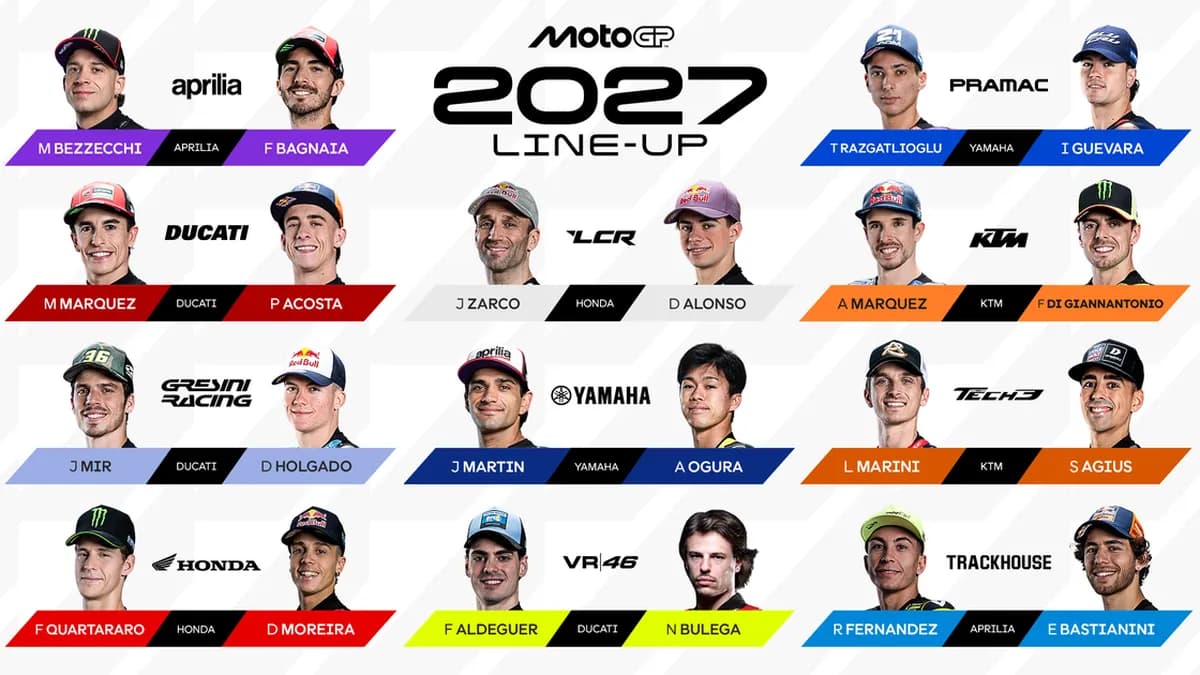
The test should be the first public look at a series of high-profile moves. According to MotoGP’s official 2027 line-up and Crash.net’s rider guide, the following riders are due to appear in new colours if their teams and contracts allow them to switch on the day.
- Pedro Acosta: from Red Bull KTM to the factory Ducati Lenovo team alongside Marc Márquez.
- Francesco Bagnaia: from Ducati Lenovo to Aprilia Racing, partnering Marco Bezzecchi.
- Jorge Martin: from Aprilia to the Monster Energy Yamaha factory team, with Ai Ogura.
- Fabio Quartararo: from Yamaha to Honda HRC, alongside Diogo Moreira.
- Alex Márquez and Fabio Di Giannantonio: both join the Red Bull KTM factory squad.
- Joan Mir: from Honda to Gresini Ducati, alongside rookie Dani Holgado.
Rookies are the other group to follow. Dani Holgado, David Alonso and Izan Guevara step up from Moto2, while Nicolo Bulega arrives from WorldSBK at VR46 Ducati and Senna Agius joins Tech3 KTM. Bulega has a head start: Crash.net has noted his extensive mileage on Pirelli’s MotoGP tyres during development work.
How to read the timesheets
Lap times from a one-day winter test should be treated with caution. Teams arrive with different programmes, some focused on tyre comparisons, some on electronics, and some simply on getting a rider comfortable on an unfamiliar bike. A headline time can come from a rider chasing a single fast lap on fresh rubber, while a rival completes long runs that look slower on paper but tell engineers far more.
The more useful signals are usually comparative: how quickly a rider who has switched manufacturers gets within range of a team-mate who stayed put, how the different manufacturers cope with Pirelli’s construction in cool conditions, and whether any bike looks obviously out of its depth. Valencia is a short, tight, mostly left-handed circuit, so it also says little about top-speed potential on longer tracks.
The previous in-season tests did give hints. At the Red Bull Ring in September, Honda set the pace and several 850cc prototypes lapped faster than the 2026 race bikes had managed that weekend, a reminder that the smaller engines will not necessarily mean slower bikes once development matures.
What comes next
After Valencia, the winter testing ban applies and the next on-track running is in Malaysia. The Sepang shakedown is scheduled for 29–30 January 2027 for test riders and rookies, followed immediately by the official Sepang test on 31 January and 1 February. Both Sepang sessions have been cut from three days to two. The final pre-season test follows at Buriram on 6–7 February, before the season launch in Rio on 21 February.
For Malaysian fans, that makes Sepang the first chance to see the new bikes and new pairings in person, little more than two months after Valencia. The data gathered on 1 December will shape the winter development work that teams bring to Sepang, so the Valencia test is effectively the opening chapter of the 2027 season, even though it takes place in 2026.
This preview was written before the 2026 Valencia Grand Prix and before the test itself. Programmes, rider availability and the final format can still change, so check official team and MotoGP channels on the day for confirmation of who rides what.
Sources
- Motorcycles.News: Motul Gran Premio de la Comunitat Valenciana 2026
- The Race: MotoGP 2027 testing – dates and tracks announced
- Crash.net: Outgoing KTM MotoGP rider pushing for major 2027 testing change
- Crash.net: 2027 MotoGP pre-season testing dates revealed, Sepang shortened
- Crash.net: The complete 2027 MotoGP rider line-up
Like what you read?
Register now and put today's slate to work.